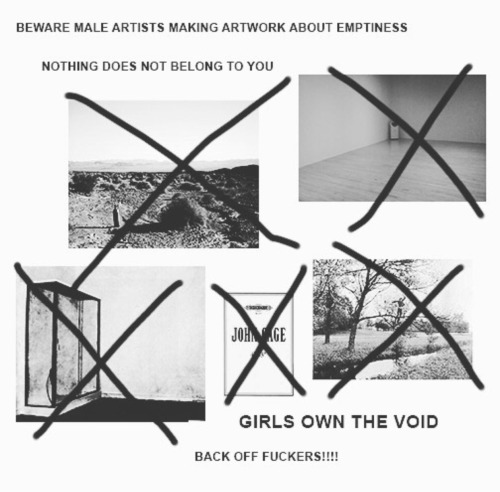
ok but HAVE I TALKED ABOUT VAGINAL ART and how ANYTHING that a woman makes is about the hollow in her body?
ok i CANT RESIST
[T]o be a woman is to be an object of contempt, and the vagina, stamp of femaleness, is devalued. The woman artist, seeing herself as loathed, takes that very mark of her otherness and by asserting it as the hallmark of her iconography, establishes a vehicle by which to state the truth and beauty of her identity.
—Judy Chicago and Miriam Schapiro, 1972
Chicago, too, insists that her vaginal imagery be read not literally, but metaphorically, as an active and powerful symbol of female identity. Long before she began work on The Dinner Party, Chicago had been attempting to anthropomorphize the vulvae form, transforming it into numerous motifs suggesting caves and flowers. She eventually fused those abstract “core” images with the butterfly, an ancient symbol of liberation and resurrection, producing “a metaphor for an assertive female identity.”10 She had finally arrived at her signature “central core” form: an active vaginal form, or her equivalent to the flying phallus from Greek art. The imagery of The Dinner Party plates incorporates this butterfly-vulvae motif. Each plate fuses an abstract portrait with an (active) butterfly form. As the visitor circumnavigates the table, the butterfly form surges up dimensionally, symbolizing women’s increased strides toward liberation from prehistory to the modern era.
(from the brooklyn museum) ((which babe we should definitely go there and see the dinner party, its a behemoth a piece and it makes me have FEELS)
judy chichago “menstruation bathroom”
sandy orgel “linen closet”
honestly the feminist art of the 70s (especially judy chicago what a character) is super fascinating and also extremely important to the development of contemporary art and ugh when i get back into the 20th century in art history i am not going to shut up about readymade and dada and void art and whooooooo boy am i going to look at it through a contemporary intersectional feminist viewpoint uh HUH
ok because i CANT SHUT UP ABOUT THIS POST APPARENTLY
audrey wollen holy shit what a mind
“What if we could reframe any girl that killed herself, starved herself, was unhappy — as an activist?” she asked. “By placing them as activists, we now have a story of a war that wasn’t being considered as such.”
“I’m much more likely to reach the 12-year-old girl who hates herself on Instagram than in a white cube gallery space,” Wollen said.
While it may sound like she has a contentious relationship with traditional art venues, the choice of presenting her work online is born out of her goals as an artist as well as her financial reality.
“I can’t really wait around to be invited to have a gallery show. When you make [art], you have to put it somewhere, and that somewhere is usually the Internet,” she explained. “Internet artists are sometimes artists who don’t have any money, because they can’t invest a lot of money into making a massive sculpture.”
At the center of Wollen’s art practice, girlhood and sadness are inextricably tied in what she has christened “Sad Girl Theory.” It’s the proposal that the sadness of girls should be witnessed and reframed as an act of political protest rather than a personal failure.
“A woman in public at all is an intense, brave thing to do — not like public, left your house — but public discourse, a space that is not individualized and not set within boundaries of the home. It can be dangerous to do on a basic level,”
“When people abuse a girl online, the moment when the patriarchy reveals itself at its most brutal, is generative and good. Now it’s witnessable — it’s not just in the secret corners,” said Wollen.
This is Sad Girl Theory in action — recognizing the moments when you feel the most powerless and imbuing them with power. The experience of doing so, however, is admittedly not an easy one.
“If your feminism isn’t painful, you’re not doing it right,” said Wollen as she stirred a spoonful of honey into her tea cup. “Because it’s a painful thing to witness how things are and your own participation.”
“But I don’t feel like that goddess figure,” Wollen said. In fact, she admits that she doesn’t necessarily even feel like a woman. “I’m interested in undoing that kind of linearity,” says Wollen. “When does womanhood happen? When do I stop being a girl?”
Her choice of using the term “girl” rather than “woman” is a conscious one, stemming from that ambiguity. She added,”If patriarchy is constantly infantilizing me, I don’t want to reject my situation. If you’re going to be a girl forever, how can you use that to your advantage — what parts of that can we weave into our politics?”